
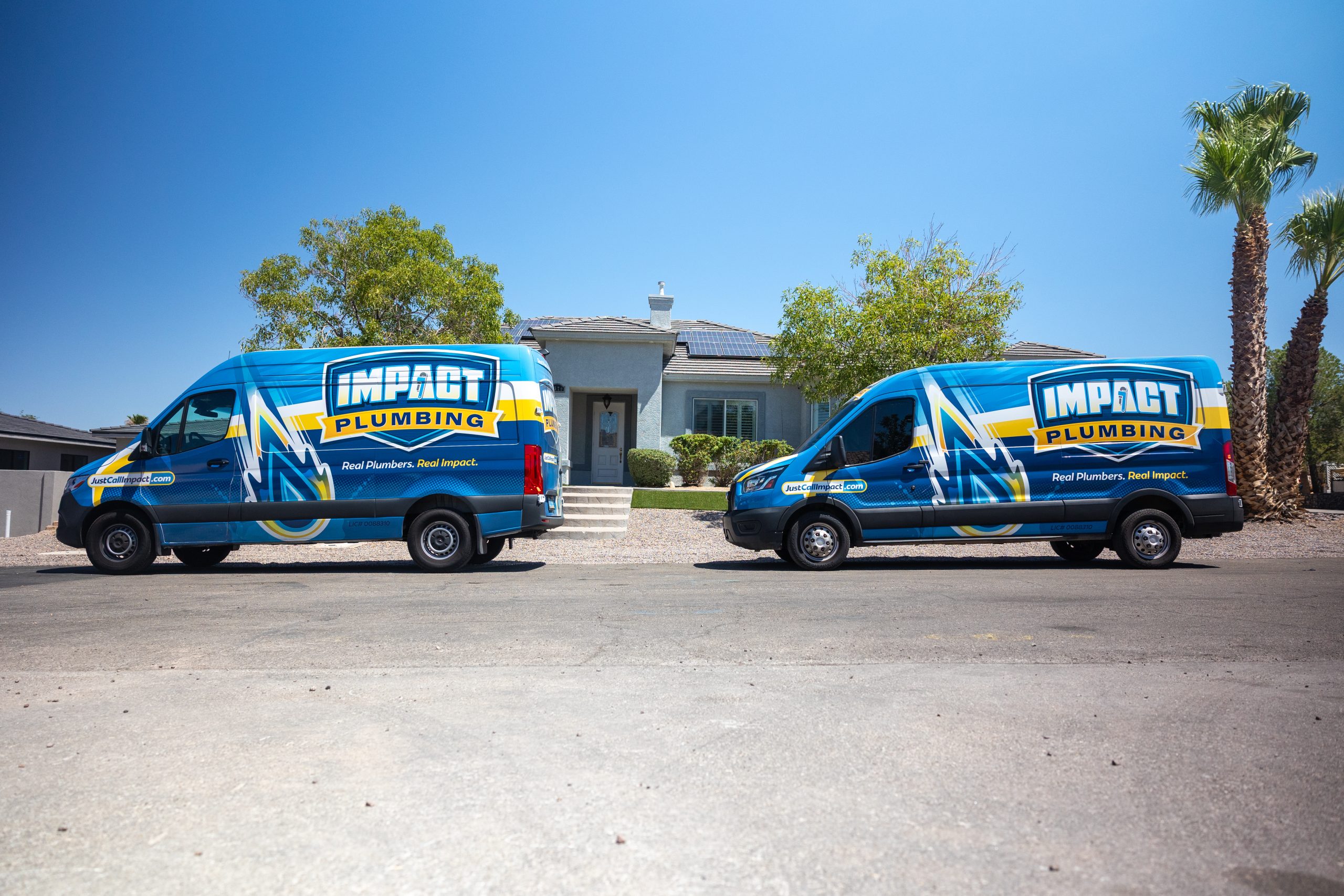
Short answer: Impact Plumbing is a licensed plumbing company (NV license #0088310) serving the City of Las Vegas 24/7, from downtown and the Scotch 80s to Centennial Hills and Skye Canyon. We repair and replace water heaters, find slab leaks, clear drains and sewer lines, and repipe homes, with a written price before any work starts.
Figures: U.S. Census Bureau and Las Vegas Valley Water District.
Key takeaways
- The City of Las Vegas has about 268,000 homes with a median year built of 1994, and more than 1 in 5 predates 1980.
- City of Las Vegas Building & Safety issues plumbing permits inside city limits. Paradise, Spring Valley and Enterprise use Las Vegas addresses but are Clark County.
- Most of the city gets Las Vegas Valley Water District water at about 16 grains per gallon; some neighborhoods next to North Las Vegas are served by that city.
- About 44% of homes were built in the 1980s and 1990s and 22% in the 2000s, the years polybutylene and Kitec were on the market.
- The water district says a home with pressure of 80 psi or more needs a pressure regulator, and the homeowner owns and maintains it.
Las Vegas at a glance
| Neighborhoods | Downtown, Arts District, Scotch 80s, Rancho Circle, Charleston Heights, The Lakes, Peccole Ranch, Desert Shores, Summerlin North, Centennial Hills, Skye Canyon |
|---|---|
| ZIP codes | 89101, 89102, 89104, 89106, 89107, 89108, 89117, 89128, 89129, 89130, 89131, 89134, 89143, 89144, 89145, 89149, 89166 |
| Homes | About 268,000; median year built 1994 |
| Water provider | Las Vegas Valley Water District for most of the city; City of North Las Vegas Utilities in some neighborhoods next to North Las Vegas |
| Water hardness | About 16 grains per gallon (280 ppm), very hard |
| Sewer | City of Las Vegas |
| Plumbing permits | City of Las Vegas Building & Safety |
| HOA | Varies; planned communities have associations, many older neighborhoods do not |
What plumbing problems are common in Las Vegas?
The most common Las Vegas calls are water heaters worn down by hard water, slab leaks, aging pipe in central neighborhoods, and checks for polybutylene or Kitec in homes built while those products were sold.
| When the home was built | Share of Las Vegas homes | What we see most |
|---|---|---|
| Before 1980 | 23% | Galvanized steel supply lines, cast-iron drains and older sewer laterals |
| 1980 to 1999 | 44% | Polybutylene checks (installed through mid-1995), second or third water heaters, worn shutoff valves and regulators |
| 2000 to 2009 | 22% | Kitec checks, slab leaks, first and second water heater replacements |
| 2010 or later | 12% | Tankless descaling, softener and filtration installs, leak shutoff valves |
Hard water and water heaters
Las Vegas Valley Water District water averages about 16 grains per gallon. Sediment settles in tank water heaters and scale coats tankless heat exchangers, so a yearly flush or descaling noticeably extends their life.
Older pipe in central neighborhoods
More than 1 in 5 Las Vegas homes predates 1980. In mid-century neighborhoods like the Scotch 80s, Rancho Circle and Charleston Heights, original galvanized steel water lines and cast-iron drains may still be in place, and both corrode from the inside.
Polybutylene and Kitec checks
Polybutylene is gray plastic supply pipe; Kitec is orange and blue flexible pipe with brass fittings. Both are easy to spot at the water heater or under a sink, and we can tell you whether yours needs attention now or can be monitored.
Slab leaks
Most homes here sit on concrete slabs, so a leaking hot-water line shows up as a warm spot on the floor, a water meter that spins with everything off, or a sudden jump in your bill. We locate it, then repair or reroute the line.
How old are Las Vegas homes, and why does it matter for plumbing?
The median Las Vegas home was built in 1994. Age decides which parts are wearing out: water heaters, regulators and shutoff valves first, then the pipe itself in older homes.
| Las Vegas homes | Figure |
|---|---|
| Homes (housing units) | 267,654 |
| Median year built | 1994 |
| Built before 1980 | 23% |
| Built 1980–1999 | 44% |
| Built 2000–2009 | 22% |
| Built 2010 or later | 12% |
| Single-family detached houses | 62% |
| Mobile or manufactured homes | 1% |
| Homes heated with utility gas | 58% |
| Homes heated with electricity | 39% |
Source: American Community Survey 2020-2024 5-year estimates for the City of Las Vegas. Percentages are rounded and, like all survey estimates, have margins of error.
Las Vegas homes span most of the 20th century. About 44% were built in the 1980s and 1990s and 22% in the 2000s, the years when gray polybutylene (installed through mid-1995) and Kitec (sold 1995–2007) were on the market. Neither pipe is in every home from those years, but both are worth ruling out.
Do Las Vegas homes have Kitec or other problem pipe?
Some do. Kitec was installed in Southern Nevada homes from 1995 to 2006, and 22% of Las Vegas homes were built in the 2000s. Many homes from those years never had it and others were repiped after the class action, so the only way to know is to look.
Kitec is flexible pipe, usually orange for hot and blue for cold, joined with brass fittings. The Las Vegas Sun reported that water corrodes the brass, the buildup restricts flow, and fittings eventually fail; the class action covered at least 34,000 Southern Nevada homeowners. You can usually spot it where pipes come out of the wall at the water heater or under a sink.
Homes built from the late 1970s to mid-1995 can have gray polybutylene instead, which the Cox v. Shell settlement covered when installed from 1978 through July 1995. 44% of Las Vegas homes were built from 1980 to 1999. In the 23% of homes built before 1980, original galvanized steel water lines are the bigger concern: they rust from the inside, which cuts pressure and can tint the water brown. If you find any of these, we can tell you whether the home was already repiped, and price a repipe or a targeted repair.
Is water pressure a problem in Las Vegas?
It can be. The Las Vegas Valley Water District says pressure depends on your home's elevation relative to the reservoir that serves it, and generally runs from about 30 to 100 psi. At 80 psi or more, a home needs a pressure regulator.
- Who owns the regulator: you do. The water district says property owners install and maintain their own.
- Where it is: on your side of the meter, usually near the water heater, the softener or where the line enters the house.
- What it should read: the district notes most plumbers recommend a setting between 35 and 60 psi.
- Signs it is failing: banging pipes, toilets that run or fill loudly, dripping relief valves, or pressure that swings through the day.
Neighborhoods sit at different elevations and pressure zones, so two streets a mile apart can have very different pressure. Regulators wear out, so a home still on its original one is worth checking. We test with a gauge at a hose bib, then adjust or replace it.
Who supplies water in Las Vegas, and how hard is it?
Most of the city gets its water from the Las Vegas Valley Water District, and the City of North Las Vegas serves some neighborhoods next to its border. About 90 percent of LVVWD water comes from Lake Mead and the rest from wells, and the district's latest report lists hardness at 280 ppm, about 16 grains per gallon. LVVWD notes that homes in the northwest valley may receive a blend of well water and Lake Mead water.
A softener stops new scale, and reverse osmosis handles drinking water. See water filtration and treatment and water softeners.
Do you need a permit for plumbing work in Las Vegas?
Yes, for many jobs. Inside city limits, City of Las Vegas Building & Safety issues the permits. Some Las Vegas addresses are actually in unincorporated Clark County, such as Paradise, Spring Valley and Enterprise, and those go through the county. We pull the permit and schedule the inspection as part of the job.
| Jurisdiction | City of Las Vegas |
|---|---|
| Plumbing permits | City of Las Vegas Building & Safety |
| Sewer | City of Las Vegas |
| ZIP codes | 89101, 89102, 89104, 89106, 89107, 89108, 89117, 89128, 89129, 89130, 89131, 89134, 89143, 89144, 89145, 89149, 89166 |
The City of Las Vegas requires a permit to install or replace a water heater or water softener and to alter piping inside a wall, ceiling or under a floor. Its water heater guideline adds that homeowners can pull a water heater permit only for a primary residence they own, so rentals and second homes need a contractor, and every tank needs two seismic straps. Statewide, the Nevada State Contractors Board says new and replacement water heaters need a permit and an inspection.
Do you need HOA approval for plumbing work in Las Vegas?
Not for repairs inside the home. Approval only comes up in neighborhoods with an association, and only when equipment would show from outside.
Nevada homeowners associations operate under NRS Chapter 116 and their own CC&Rs, and design review generally covers what can be seen from outside. If a softener, tankless unit or any piping would be visible from the street or a neighbor's yard, check with your association before work starts. A building permit is still required either way.
Many older Las Vegas neighborhoods have no association, while planned communities like Desert Shores, The Lakes, Peccole Ranch and Summerlin North do. In a condo or townhome, the association may also be responsible for pipes in shared walls, so check your CC&Rs before work on a shared line.
Is there a 24-hour emergency plumber in Las Vegas?
Yes. Impact Plumbing answers 702-941-8897 around the clock and sends licensed plumbers to every Las Vegas neighborhood for burst pipes, slab leaks, sewer backups and water heaters that quit.
While you wait:
- Shut off the water at the main valve, usually where the line enters the house or in the garage. If it will not turn, the shutoff at the meter box by the street works too.
- Turn off the water heater if it is leaking: the gas control to off or pilot, or the breaker for an electric unit.
- If you smell gas, leave first and call Southwest Gas and 911 from outside.
Our shop is at 4710 W Dewey Dr in the southwest valley, and we cover the whole city, from downtown and the Scotch 80s to Centennial Hills and Skye Canyon. See 24/7 emergency plumber.
Which plumbing services do Las Vegas homes need most?
Every service below is available in Las Vegas, 24/7 for emergencies. Which ones a home needs depends a lot on when it was built.
- Water heater repair in Las VegasPilots, gas valves, elements and thermostats, with a straight answer on repair versus replacement.
- Water heater replacement in Las VegasPermit and inspection through City of Las Vegas Building & Safety, and haul-away of the old unit.
- Tankless water heaters in Las VegasDescaling, repair and new installs. With water this hard, yearly descaling prevents most error codes.
- Leak and slab leak detection in Las VegasWe pinpoint leaks under the slab before opening any floor, then repair or reroute the line.
- Drain cleaning in Las VegasKitchen, bath and main line clogs cleared, with a camera when a clog keeps coming back.
- Hydro jetting in Las VegasHigh-pressure cleaning for grease and buildup that a cable only pokes a hole through.
- Sewer line repair in Las VegasCamera inspection first, so you see the problem before you approve the repair.
- Main water line repair in Las VegasLeaks between the meter and the house, found and repaired, including lines under driveways and yards.
- Repiping in Las VegasWhole-home replacement of galvanized steel or polybutylene pipe, with the permit handled for you.
- Water filtration and treatment in Las VegasSofteners, carbon filtration and reverse osmosis sized for very hard valley water, starting with a free water test.
- Water softeners in Las VegasNew installs and replacements of worn-out units, with the City of Las Vegas permit.
- Smart leak shutoff valves in Las VegasAutomatic shutoff for second homes and frequent travelers, with a water authority rebate of up to $200.
- Commercial plumbing in Las VegasService for restaurants, shops and offices, from downtown and the Arts District to the northwest.
- 24/7 emergency plumber in Las VegasA person answers around the clock for burst pipes, slab leaks and sewer backups.
How does a plumbing visit work in Las Vegas?
Every visit follows four steps, and you approve a written price before any work starts.
- Call or book online. Dispatch gives you an arrival window and texts when your plumber is on the way.
- Diagnosis and a written price. Your plumber finds the cause and gives you a written price. You approve it before any work starts.
- Work done to code. When a job needs a permit, we pull it through City of Las Vegas Building & Safety and schedule the inspection.
- Test and clean up. We test the repair, clean the work area and walk you through what was done.
Which Las Vegas neighborhoods and ZIP codes do you serve?
All of them, from downtown, the Arts District and the Scotch 80s to The Lakes, Centennial Hills and Skye Canyon.
- Downtown
- Arts District
- Scotch 80s
- Rancho Circle
- Charleston Heights
- The Lakes
- Peccole Ranch
- Desert Shores
- Summerlin North
- Centennial Hills
- Skye Canyon
ZIP codes: 89101, 89102, 89104, 89106, 89107, 89108, 89117, 89128, 89129, 89130, 89131, 89134, 89143, 89144, 89145, 89149, 89166
Nearby areas we serve
We also serve the communities around the city, from Summerlin and Desert Shores to North Las Vegas, Spring Valley, Winchester and Paradise.
Sources
- Las Vegas Valley Water District, Water Quality Report (2026, 2025 data) (hardness 280 ppm (16 gpg); about 90% Lake Mead, 10% groundwater)
- Las Vegas Valley Water District, Las Vegas Valley water quality (northwest valley may receive a groundwater and Lake Mead blend; water drawn deep in Lake Mead through Intake No. 3; Rocky Mountain snowmelt)
- Southern Nevada Water Authority, water purveyor overview (2006 exhibit) (North Las Vegas serves adjacent parts of Las Vegas; LVVWD serves Las Vegas and unincorporated areas)
- Nevada State Contractors Board, Permits Required for Water Heaters (permits and inspections required for new and replacement water heaters)
- U.S. Census Bureau, American Community Survey 2020–2024 5-year estimates for the City of Las Vegas (via Census Reporter) (housing units, year built, units in structure, heating fuel)
- CONTRACTOR magazine, polybutylene settlements (Cox v. Shell covered polybutylene installed Jan. 1, 1978–July 31, 1995)
- CBC News, Kitec class-action settlement (Kitec sold 1995–2007; brand names; $125 million settlement)
- Southern Nevada Water Authority, Smart leak detector rebate (50% of the price or $200, whichever is less; SNWA member agency customers; one per property)
- Las Vegas Valley Water District, Water pressure (pressure depends on elevation relative to the reservoir; generally 30 to 100 psi; a pressure reducing valve is needed at 80 psi or more; owners install and maintain their own; usual setting 35 to 60 psi)
- City of Las Vegas Building & Safety, When do I need a permit? (permit required to install or replace a water heater or water softener, or to alter piping inside a wall, ceiling or beneath a floor)
- City of Las Vegas Building & Safety, Residential water heater installation guideline (permit required to install, move, remove or replace any water heater; homeowners may pull it only for a primary residence they own; two seismic straps required)
- Las Vegas Sun, Tentative settlement reached in defective plumbing lawsuit (Oct. 24, 2008) (Kitec used in Southern Nevada homes from 1995 to 2006; at least 34,000 homeowners in the class action; brass fittings corrode and restrict flow)
- Nevada Legislature, NRS Chapter 116, Common-Interest Ownership (the state law that governs most Nevada homeowners associations)